
 By Harish
This is where custom mobile app development plays a critical role.
Custom mobile app development focuses on building applications specifically tailored to a business’s unique requirements, users, and goals. Instead of forcing your business processes to fit a pre-built app, a custom mobile app is designed around how your business actually works both today and in the future.
Whether you are a startup building your first product, a growing business aiming for scale, or an enterprise looking for advanced security and integrations, understanding custom mobile app development is essential before making any investment decision.
In this detailed guide, you’ll learn:
- What custom mobile app development is
- Key features and benefits
- How the development process works
- Real-world examples
- When and why custom apps outperform ready-made solutions
What Is Custom Mobile App Development?
Custom mobile app development refers to the end-to-end process of designing, developing, testing, and deploying a mobile application that is built exclusively for a particular business or use case.
Unlike off-the-shelf or template-based apps, custom apps are:
- Designed after detailed requirement analysis
- Built with only necessary features
- Optimized for specific user behavior
- Developed with scalability and future expansion in mind
In custom development, every element of the app from user interface and backend logic to security architecture and third-party integrations is purpose-built.
In simple terms:
Custom mobile app development means building an app that adapts to your business, not the other way around.
Custom Mobile App Development Meaning
To understand the meaning clearly, let’s simplify it.
Imagine two scenarios:
- You buy a ready-made shirt from a store.
- You get a shirt stitched exactly to your size, style, and comfort.
A ready-made mobile app is like the store-bought shirt it may fit, but never perfectly. A custom mobile app is like a tailored shirt designed exactly for you.
Custom mobile app development means:
- Your business decides what features the app should have
- Your users influence how the app looks and behaves
- Your growth plans define how scalable the app needs to be
This approach ensures that the app supports your business strategy instead of limiting it.
Types of Custom Mobile App Development
1. Custom Android App Development
Apps built specifically for Android devices using technologies like Kotlin or Java, optimized for the Android ecosystem.
2. Custom iOS App Development
Apps designed exclusively for Apple devices using Swift or Objective-C, focusing on performance, security, and Apple UI standards.
3. Cross-Platform Custom App Development
Single codebase apps built using frameworks like Flutter or React Native, deployed on both Android and iOS with shared logic.
The choice depends on your audience, budget, performance needs, and time-to-market goals.
Key Features of Custom Mobile App Development
1. Tailored Functionality
Custom apps include only features your business actually needs no unnecessary clutter, no missing capabilities.
2. Superior Performance
Since the app is built from scratch, the codebase is clean and optimized, resulting in:
- Faster load times
- Smooth navigation
- Better responsiveness
3. Scalability & Flexibility
Custom apps are designed to grow with your business. New features, APIs, or integrations can be added without rebuilding the entire app.
4. Advanced Security
Custom mobile apps implement robust security practices such as:
- Secure authentication systems
- Encrypted data storage
- Secure API communication
- Compliance with industry standards
This is especially important for fintech, healthcare, and enterprise apps.
5. Unique UI/UX Design
You get a brand-focused design that aligns with your visual identity and user expectations not a reused template.
6. Seamless Integrations
Custom apps can integrate with:
- CRM systems
- ERP software
- Payment gateways
- Analytics tools
- AI or ML engines
Custom Mobile App Development Process
Step 1: Requirement Analysis
This phase involves understanding:
- Business objectives
- Target users
- Core features
- Monetization strategy
- Technical constraints
A strong foundation here prevents costly changes later.
Step 2: UI/UX Design
Designers create wireframes and prototypes focusing on:
- User journeys
- Navigation flow
- Accessibility
- Brand consistency
Step 3: App Development
Developers build:
- Frontend (what users see)
- Backend (logic, databases, APIs)
This phase follows best coding practices for performance and security.
Step 4: Testing & Quality Assurance
The app is tested for:
- Bugs and crashes
- Performance issues
- Security vulnerabilities
- Compatibility across devices
Step 5: Deployment
The app is launched on:
- Google Play Store
- Apple App Store
Step 6: Maintenance & Updates
Post-launch support includes:
- Bug fixes
- Feature enhancements
- Performance optimization
Examples of Custom Mobile App Development
Example 1: E-Commerce App
A business builds a custom e-commerce app with:
- Personalized recommendations
- Custom checkout flow
- Advanced analytics
- Inventory system integration
Example 2: EdTech App
A learning platform develops a custom app featuring:
- Student dashboards
- Live and recorded classes
- Performance tracking
- AI-based doubt resolution
Example 3: Healthcare App
A healthcare startup builds a secure app with:
- Patient record management
- Appointment scheduling
- Video consultations
- Compliance-ready data storage
These use cases cannot be efficiently handled by ready-made apps.
Custom Mobile App Development vs Ready-Made Apps
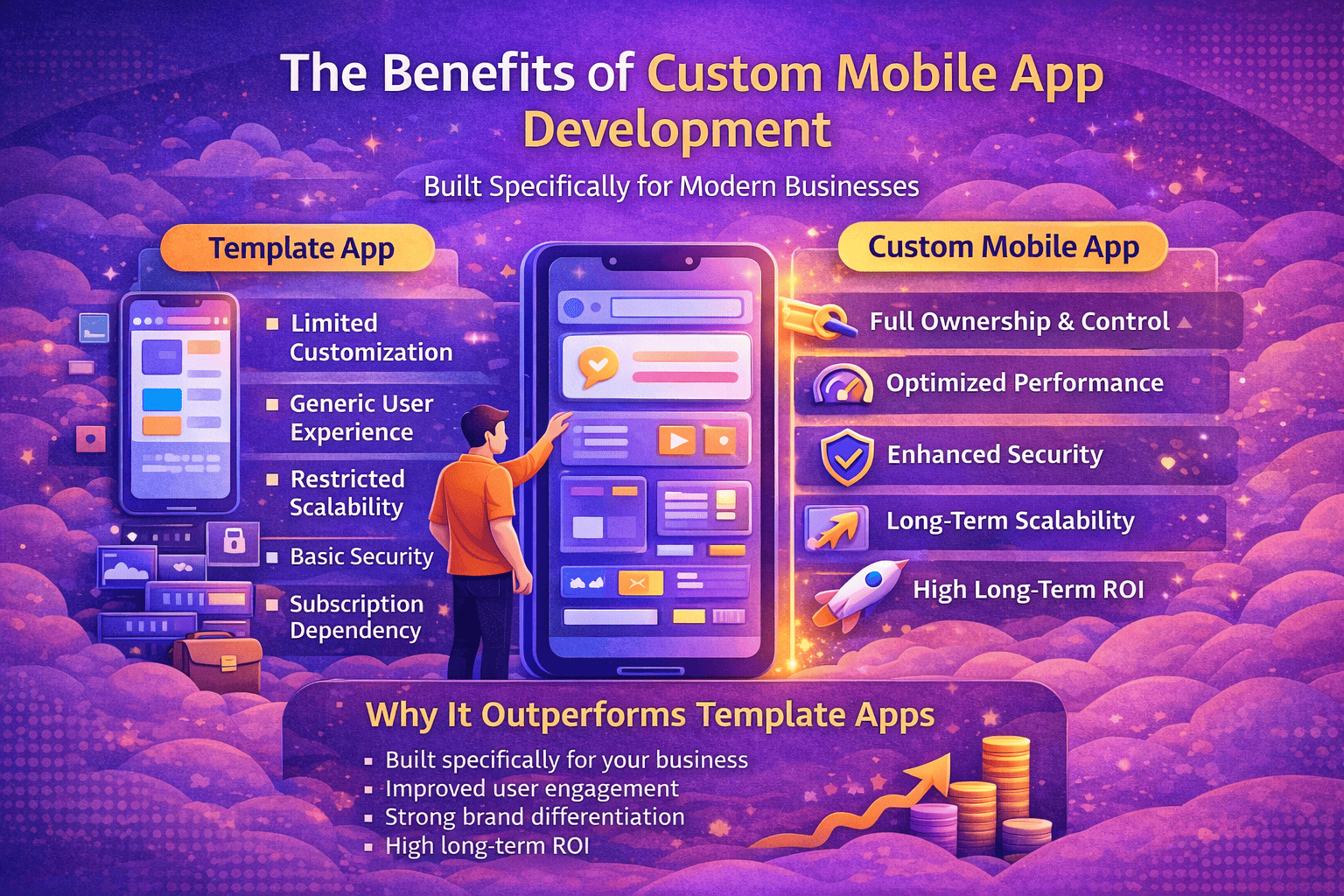
| Parameter | Custom Mobile App | Ready-Made App |
|---|---|---|
| Customization | Full | Limited |
| Scalability | High | Restricted |
| Performance | Optimized | Average |
| Security | Advanced | Basic |
| Ownership | Complete | Partial |
| Long-Term ROI | High | Low |
Benefits of Custom Mobile App Development
- Full ownership and control
- Better user engagement
- Strong brand differentiation
- Long-term cost efficiency
- Higher customer retention
While the initial investment may be higher, the long-term business value is significantly greater.
Who Should Choose Custom Mobile App Development?
Custom mobile app development is ideal for:
- Startups with unique product ideas
- Businesses planning long-term scale
- Enterprises with complex workflows
- Companies handling sensitive data
- Brands focused on superior user experience
If your app is central to your business, custom development is the right choice.
Custom mobile app development is the process of creating a mobile application from scratch based on a business’s specific needs, users, and objectives. Unlike template or ready-made apps, custom apps offer complete control, better performance, enhanced security, scalability, and long-term flexibility making them ideal for startups, enterprises, and businesses planning sustainable growth.
FAQ'S
Custom mobile app development is the process of building a mobile application from scratch, tailored to a business’s specific needs and users.
Custom apps offer complete control, scalability, and security, while template apps have predefined features and limitations.
Initial costs are higher, but custom apps deliver better ROI, flexibility, and long-term growth benefits.
E-commerce, healthcare, edtech, fintech, logistics, and enterprise businesses benefit significantly.
Yes. Custom apps are designed for easy updates, feature expansion, and system integrations.